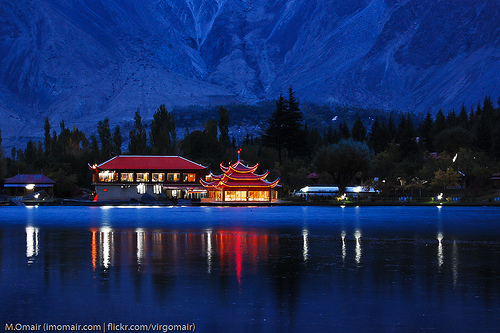
The Northern Area is the most spectacular and fascinating region of Pakistan. It is here that the world's three famous mountain ranges meet - the Himalayas, the Karakorams and the Hindukush. The whole Northern Pakistan has come to be known as a paradise for mountaineers, climbers, trekkers, hikers and the most famous “Trout fish”.
 GILGIT
At an elevation of 1,454 metres lies the Gilgit Valley. The quaint little town of Gilgit has spectacular scenic beauty. The peak tourist season is from April to October though you can visit the valley round the year. The maximum temperature in May is 33 C and the minimum 16 C and in September, maximum 28 C and minimum 11 C.
PLACES TO VISIT
Gilgit Bridge:
The bridge over the fast flowing
Gilgit River, at the end of its traditional bazaar, is the largest suspension bridge in
Asia (182 metres long and 2 metres wide) permitting enough room for one jeep at a time to cross.
Kargah Buddha:
Located on a rock near Kargah Nullah (ravine), 10 km. from Gilgit town is a beautiful rock engraving of Buddha from 7th century A.D.
Monument of Taj Mughal:
A victory
monument of Taj Mughal, built 700 years ago, is 30 km. jeep drive from Gilgit town.
Sher Qilla:
It is 38 km. from Gilgit - Trekking route links with Naltar valley. Trout fishing can be enjoyed in Sher Qilla Nullah and a small lake.
Singal:
About 61 km from Gilgit - Trekking route links with Chilas and Kohistan valley.
Gahkuch:
Headquarter of Ghizer District - Ideal place for trekking, good fishing sports and duck shooting in season. It is the gateway to
Iskoman Valley. Government rest house and private hotels are available (73 km from Gilgit). Archaeological sites in village and a near by village Hatoon.
Naltar Valley:
Two hours jeep drive from Gilgit link rod. Government Rest house, Private hotels and a Ski slope, lush green Alpine forest with small lakes and glaciers, trout fishing in lake. Trekking routes link with Iskoman, Chalt and Punial valley.
SKARDU
Skardu, is 2,438 metres above sea level in the backdrop of the great peaks of the Karakorams. Balti people are a mixture of Tibetan and Caucasian stock and speak Balti, an ancient form of Tibetan. Due to the similarity of its culture, lifestyle and architecture with
Tibet, Baltistan is also known as the "Tibet-e-Khurd" (Little Tibet). It borders on the Chinese
province of
Xinjiang and Indian-occupied
Kashmir. The tourist season is from April to October. The maximum temperature is 27 C and minimum (October) 8 C. Apart from its incomparable cluster of mountain peaks and glaciers Baltistan's five valleys - Shigar, Skardu, Khaplu, Rondu and Kharmang are noted for their peaches, apricots, apples and pears.

Skardu is linked to the
Islamabad by PIA, which operates one flight daily. The air journey is full of thrills and would itself be regarded as the highlight of the visit. After following the same air route, which connects Gilgit to Islamabad/Rawalpindi, the plane turns right and flies over the gorge of the
Indus River. Enormous rock faces rise on either side or at times it seems as if the wing tips of the plane would almost scrape against them. They never do. Baltistan is known as the "Tibet-e-Khurd", or Little Tibet since its life-style reflects that of the Roof of the World and the
Land of Lamas.
HUNZA

The visitors to Hunza are overwhelmed by the rugged charm, the fragrant breeze singing through graceful Poplar trees and the velvet-like green carpet of wheat fields, set against the background of snow-covered mountains. Situated at an elevation of 2,438 metres,
Hunza Valley's tourist season is from April to October. The temperature in May is maximum 27 C and minimum 14 C. The October temperature are: maximum 10 C and minimum 0 C. However, one can visit Hunza round the year.
Most of the people of Hunza are Ismaili Muslims, followers of His Highness the Aga Khan. The local language is Brushuski. Urdu and English are also understood by most of people. Karimabad, the capital of Hunza, offers an awe-inspiring view of Rakaposhi 7,788 metres. The snows of Rakaposhi glitter in the moonlight, producing an atmosphere at once ethereal and sublime.
The fairy-tale like
castle of Baltit, above Karimabad, is a Hunza landmark built about 600 years ago. Stilted on massive legs, its wooden bay windows look out over the valley. Originally, it was used as the residence of the Mirs (the title of the former rulers) of Hunza.
Mountaineering And Hiking
Hunza is ideal for mountaineering, trekking and hiking. Most of the treks in Hunza area are in open zone, for which tourists do not need any permit. However special permits are required from the Ministry of Tourism,
Islamabad for mountaineering, trekking in restricted zone & climbing peaks over 6000 metres.
CHITRAL
This 322 km.(200-mile) long mountain hideout, nesting high in the
Hindu Kush range, is a place of fascinating scenic beauty and grandeur. Chitral’s collection of rugged mountains, sulphur springs, rivers teeming with trout, orchard-dotted slopes, friendly people and annual festivals are enchanting beyond description. For the modern day traveler this scenic region offers an exciting experience. It is easily accessible by air from historic city of
Peshawar. Alexander of Greece marched through this valley in 327 B.C, and left behind traces of Greek heritage, which can still be seen.
Chitral District is bounded on the north, south and the west by
Afghanistan and is separated from the Soviet Union by a narrow strip of Wakhan, a
province of
Afghanistan and from
China by Hunza area. It lies between latitude 35 51 N and longitude 71 47’E.
Area And Elevation
Area: 14504 square meters (5,600 square miles).

Elevation: 1278-7700 meters (3700-25264 feet).
Climate
Summers are generally pleasant but the winters are extremely cold. Chitral has unpredictable during spring with frequent rains and snowfall. Autumn is pleasant with mild temperatures.
Tourist Season
Ideal time for visiting Chitral is from June to September.
Population
1,59,230
Majority of the people are Muslims. The only non-Muslim ethnic minority in the Chitral valley are the Kafir Kalash. Numbering about 2,500 to 3,000 they inhabit Birir, Bumburet and Rambur valleys in the south of Chitral. Their life style is characterized by their own ancient and religion.
Languages
The local dialect is ‘Khowar’ (Chitrali). Urdu is understood by a large number of people while Pushto is spoken and understood in Chitral and Drosh.
Costumes
The women wear ‘shalwar-kameez’ (long shirts with baggy trousers) and ‘dupattas’ (flimsy scarves draped round the Shoulders).
In winter the man wear ‘shuqa’, loose ,long woolen gowns with long sleeves. The popular headdress is ‘pakol’ which is also of woolen material.
Chitral is famous for its polo tournaments, held from April to July and September to October.
KALASH
 Elevation:
 1670-2309 meters (5,476-7,576 feet).
Distance: 32-36km. (20-22 miles) south of Chitral.
By jeep: 2 ½ hours
These are a group of three small valleys: Brir, Bumburet and Rambur. Brir lies at the southern most tip of Chitral at a distance of 34 km (21 miles) and is easily accessible by jeep-able road via Ayun. It is especially ideal for those not used to trekking. Bumburet, the largest and the most picturesque valley of the Kafir Kalash, is 36 km.(22 miles) from Chitral and is connected by a jeep-able road.

Rambur is 32 km (20 miles) from Chitral, the road is jeep-able. Foreign tourists require permits for visiting the Kalash valleys. Permits are issued free of cost by the Deputy Commissioner, Chitral, Tel: 1. Foreign visitors have to pay a toll tax of Rs.10 per person while Re. 1.00 per person is charged from domestic tourists.
These valleys have an alpine climate. The people inhabiting these valleys are the primitive pagan tribes of
Pakistan, who are known as Kafir Kalash, which means the wearers of the black robes. Their origin is cloaked in controversy. A legend says that soldiers from the legions of the Macedonian conqueror, Alexander, settled in Chitral and are the progenitors of the Kalash.

They live in small villages built on the hillsides near the banks of streams. Their houses are constructed of rough-hewn logs and are double storeyed because of the steepness of the slopes. Kalash are very lively people and are famous for their lively religious festivals namely: Chilimjusht (spring), Phool (September) and Chowas (from 21st December for a week). The Kalash love music and their instruments are drums and flutes. Their colorful dances impart a feeling of peace, joy and contentment. If you join them in their dance, they interpret it as a sign friendship and will open their hearts to you and reveal some of their mysteries, their joys and sorrows. You depart with a sense of poignancy and nostalgia for these beautiful children of nature and nagging fear that all the sweetness and innocence may soon be swept away forever by the power and intolerance that often hide themselves under the banner of progress.
GARAM CHASHMA
 Elevation: 1859 meters (6,100) feet).
Distance:45 km, (28 miles) north-west of Chitral. By jeep: hours.
Elevation: 1859 meters (6,100) feet).
Distance:45 km, (28 miles) north-west of Chitral. By jeep: hours.
This un-spoilt enchanting valley of orchards, verdant fields and snow clad peaks is renowned for its boiling sulphur springs which are famous for healing effect on skin diseases, gout, rheumatism and chronic headaches. For the convenience of tourists “humans” (baths) have been constructed near the springs. Foreign tourists are requested to pay a toll tax of Rs.5.00 per person.